Hey there, thanks for swinging by—whether you’re a fellow automation nerd, someone just figuring out what pneumatic actuators actually do, or a first-time buyer checking specs, this post is for you. I’m part of a small, no-BS pneumatic actuator supply team, and I’ve lost count of how many times someone’s asked me: “Wait, what are these things even made of? I thought it was just metal and plastic?” Spoiler: it’s way more specific than that, and the material choice is what makes a good actuator last 10 years vs. crapping out in 12 months. Let’s dive in—no textbook jargon, promise. Pneumatic Actuator

First, let’s keep it real: pneumatic actuators run on compressed air, right? So they’re exposed to all sorts of stuff—moisture, dust, extreme temps, sometimes even weird chemicals in factories (think food processing or pharmaceuticals). The materials have to hold up, not leak air like a sieve, and move smoothly every single time. Skip the cheap parts, and you’re looking at unplanned downtime that costs way more than a little extra upfront. That’s why we swear by specific materials for every part, not just grabbing random stuff from a supplier.
Let’s start with the main event: the actuator housing, the big round or rectangular shell that holds all the internal guts together. This is the face of the actuator, so it’s gotta be tough. Most standard actuators use anodized aluminum, and here’s why: it’s light (so it doesn’t add unnecessary weight to whatever you’re attaching it to), strong enough to handle 100+ PSI of compressed air, and that hard anodized coating? It fights off rust and corrosion way better than raw aluminum. We don’t use raw aluminum for housings—one humid industrial site, and you’d be replacing actuators quarterly. For heavy-duty stuff, like actuators that live outside in freezing rain or sweltering heat, we bump it up to ductile cast iron. It’s way heavier, but it can take a beating—think construction sites, mining, or outdoor water treatment plants. The only tradeoff? It needs a powder coat or epoxy finish to avoid rust, same as a car body. We always specify that upgrade for outdoor jobs, no exceptions.
Next up, the internal parts that actually do the work: the piston and the rod. The piston moves back and forth (or rotates, for rack-and-pinion actuators) to open/close valves, so it needs to slide smooth and not leak air. For pistons, we use either engineering plastic (usually acetal, sometimes called Delrin if you know the brand) or forged steel. Acetal is our go-to for standard, low-friction jobs—no lubrication needed, it doesn’t swell up if there’s a little moisture in the compressed air, and it’s light. The only downside? Don’t drop it off a roof or hit it with a sledgehammer, it’ll crack. For high-torque actuators or jobs where the piston’s under a ton of stress, forged steel is the way to go. We coat steel pistons with a thin layer of chrome or ceramic to stop corrosion and cut down on friction—no one wants a piston that sticks mid-cycle.
Then there’s the piston rod, the long metal stick that sticks out of the housing to connect to the valve or whatever you’re actuating. This part takes all the abuse—constant pushing/pulling, scraping against dirt and dust, sometimes even minor impacts. The standard here is chrome-plated carbon steel, super tough, smooth as a baby’s bottom, so seals slide over it without wearing out fast. For jobs where there’s a lot of harsh chemicals (like chemical manufacturing or food plants that use strong cleaners), we switch to 304 or 316 stainless steel. It’s more expensive, but it doesn’t rust or get pitted by acidic cleaning solutions—pitting on a rod is a one-way ticket to air leaks, so that’s a non-negotiable for food-grade or chemical duty. We also add a cover boot to the rod whenever possible—those rubber or polyurethane sleeves that keep dirt and moisture off. Game changer for extending rod life, trust me.
Now, the seals and gaskets—these are the unsung heroes, the reason actuators don’t leak air like a broken tire. Skimp on seals, and your actuator won’t move at all, or will leak so much compressed air you’re throwing money out the window. We use different seals for different jobs, because one type doesn’t fit all. For standard ambient temps (-20°F to 180°F), Nitrile rubber (Buna-N) is our workhorse. It’s cheap, holds up to regular compressed air, and resists most oils that might be in the air line. For extreme cold (think frozen food plants in the dead of winter), we switch to EPDM rubber—nitrile gets stiff when it’s cold, and stiff seals leak. EPDM stays flexible down to -60°F, no problem. For high heat, like metal stamping plants that hit 300°F, Viton rubber is the only way. It doesn’t break down or soften, even when it’s hot enough to melt plastic. We also use custom gaskets, usually silicone or polyurethane, between the housing halves to make sure there’s no air getting out there—no more hissing sounds coming from the side of the actuator.
Wait, let’s not forget the end caps, the parts that seal off the ends of the housing where the rod goes in and out. Most of the time, these are aluminum too, same as the housing, but sometimes we use cast iron for heavy duty. The only thing we care about here is that they’re perfectly machined so the seal sits tight—if the end cap has a tiny scratch, the seal will leak, and you’ll be troubleshooting at 2 a.m. when a line goes down. We send every actuator out with a quick seal check before it leaves our shop, just to avoid that headache for our customers.
Also, a quick note on specialty materials—if someone needs a pneumatic actuator for a weird job, like a pharmaceutical cleanroom where even tiny particles are a no-go, we use materials with zero outgassing. That means no plastics that shed tiny bits, no rubbers that give off fumes. For food and beverage, all our seals are FDA-approved, and the metal parts don’t react with food or cleaning chemicals. We’ve even done custom actuators for marine applications, where saltwater is a problem—full 316 stainless steel housing, rod, everything, no exceptions.
Here’s the thing that a lot of cheap actuator suppliers don’t tell you: they’ll cut corners on materials to undercut prices. A housing made of raw aluminum? It’ll rust in 6 months. A seal made of generic rubber instead of the right compound? It’ll leak after a few thousand cycles. We’d rather lose a sale than sell someone an actuator that’s gonna cause them problems down the line. Our whole team works with customers to figure out exactly what they need, not just push the cheapest thing in our catalog.
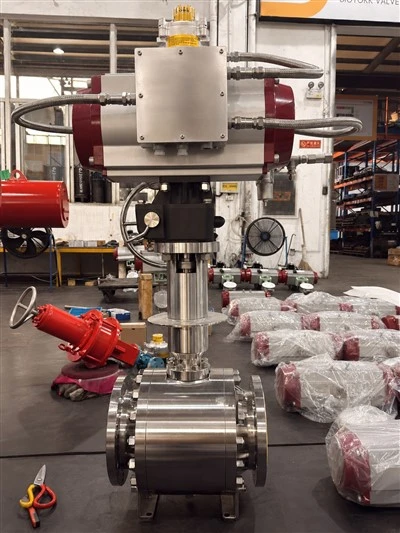
If you’re reading this and you’re shopping for pneumatic actuators—whether it’s for a single valve in your small factory or a whole line for a new plant—drop us a line and let’s chat. We can walk you through what materials will work best for your specific environment, your cycle rate, your temps, and make sure you get something that’s reliable without overpaying. No pressure, no sales pitch that feels like a used car lot—just honest advice from people who build these things every day.
Scotch Yoke Actuator References
- Pneumatic Actuator Design and Application Guide. Fluid Power Society, 2022.
- Material Selection for Industrial Pneumatic Components. International Journal of Fluid Power Systems, vol. 15, no. 2, 2021, pp. 45-58.
- FDA-Compliant Materials for Food Processing Automation. National Food Safety Association, 2023.
- Corrosion Resistance of Metal Housings for Heavy-Duty Actuators. Journal of Industrial Corrosion and Protection, vol. 19, no. 4, 2022, pp. 112-127.
- Seal Compatibility in Pneumatic Systems Across Temperature Ranges. American Society of Mechanical Engineers (ASME) Fluid Power Division, 2021.
Zhejiang Bigtork Valve Automation Co., Ltd.
Zhejiang Bigtork Valve Automation Co., Ltd. is one of the leading pneumatic actuator manufacturers and suppliers in China. We warmly welcome you to buy customized pneumatic actuator at competitive price from our factory. Contact us for more details.
Address: 98 Yuanqu Avenue,Anfeng Industrial Zone,Oubei,Yongjia,Zhejiang,China.
E-mail: sales@bigtork.com
WebSite: https://www.bigtork.com/
