Hey folks, if you’re in the wire cable industry, you know how flammability testing isn’t just a checkbox—it’s non-negotiable. Whether you’re a manufacturer cranking out cables for skyscrapers, EVs, or home wiring, your tester can make or break your compliance and safety. As someone on the ground supplying these testers for years, I’ve seen a ton of wild advancements lately that are actually fixing old headaches most of us dealt with. Let’s break down the latest stuff, no jargon, just what matters for your bottom line and your peace of mind. Wire Cable Flammability Tester

First up, real-time data integration that doesn’t feel like a chore. I remember back in the day, our old testers would spit out a paper log, and you’d spend 2 hours at the end of the week cross-referencing it with your production batch. Total waste. Now? The newest models are paired with cloud-based dashboards that pull every single test metric—burn time, flame height, drip rate, even how the material chars—right to your phone or laptop. No more typing up spreadsheets, no more lost logs. Last quarter, a client of mine who makes automotive cables told me this cut their post-test admin time by 70% and even helped them spot a tiny production flaw 2 weeks earlier than usual, before it turned into a big recall. And get this—these dashboards auto-generate compliance reports too, so when you need to submit to UL or IEC, you’re not pulling all-nighters. It’s all there, formatted exactly what the regulators want. That’s a game-changer for small to mid-sized shops that don’t have a huge compliance team.
Next, multi-test compatibility in one compact unit. A lot of people still run separate testers for vertical burn (like UL 1581 VW-1), horizontal burn (IEC 60332-1), and the new EV-specific tests (like ISO 6722 for electric vehicle cables). Before, that meant 3 big machines taking up floor space, plus moving cables back and forth between them—risking damage to samples and wasting time. Now, the latest wire cable flammability testers can run 2 or 3 of these standard tests on the same unit with just a quick software switch. We recently launched a model that fits on a single workbench (no more dedicated lab room) and handles VW-1, IEC 60332-3, and that EV drip test all in one. A client in the renewable energy space told me this freed up 15 sq ft of floor space for their new production line—space they were paying $2k+ a month for. Math checks out.
Then there’s AI-powered sample analysis that’s way more accurate than human eyes. We’ve all been there: two techs looking at the same test, one says “flame lasted 2 seconds over the limit,” the other says “just barely.” Subjectivity kills consistency, especially when regulators are cracking down on test precision. The new testers use high-res cameras (1080p+, even infrared for hidden charring) paired with basic AI to flag anomalies the second they happen. It doesn’t just capture a photo—it measures every detail: how fast the flame spreads, if drips hit the cotton below (a big red flag for fire spread), even the exact char length. We tested this with a client who had 3 techs doing manual tests, and the AI analysis matched their top tech’s accuracy 98% of the time. The other two? They were off by 5-10% consistently, just from tired eyes at the end of a shift. This isn’t replacing your techs—it’s removing the guesswork so they can focus on fixing issues, not staring at a flame for 10 minutes.
Another big one: energy efficiency and lower maintenance. Old testers ate electricity—like, a $500 a month in extra power for a unit that only runs 2 tests a week. The new models use variable flame control, so you don’t have to keep a full flame burning when you’re just prepping a sample. They also have self-diagnostic tools that tell you when a part is going bad, not after it breaks. Last year, a client had their old tester blow a heating element mid-test, ruining a $500 sample and costing them a day of downtime. Our new testers send an alert 72 hours before a component needs replacement, so you can swap it during a scheduled shift, not rush to fix it at 8pm on a Friday. On top of that, they use way less fuel—most run on propane but have a sealed burner that cuts propane usage by 40% compared to 3-year-old models. For a shop that runs tests 5 days a week, that’s $1,200 a year back in their pocket.
Wait, I can’t forget about EV-specific advancements—because that’s the hottest market right now. EV cables have unique flammability issues: they carry high voltage, so any fire can be way more dangerous, and the materials are different (more lithium-ion adjacent, thinner insulation). The latest testers have a specialized chamber that simulates the exact conditions EV cables face: higher airflow (to mimic how air moves in a car engine bay), pressure sensors to match under-hood pressure, and even a port to test the cable while it’s connected to a low-voltage power source (to see if the flame spreads to adjacent wiring). We worked with an EV components manufacturer last year who couldn’t get their cables to pass the new SAE J1642 test, and our tester let them test 12 sample variations in a week, instead of the 3 weeks they were taking before. That got their product to market 2 months early, which was a huge win for their launch.
Now, let’s talk about what you might be worried about—is this tech just for big companies? Nope. A lot of these advancements are scaling down to affordable units for smaller manufacturers or labs. We have a compact, entry-level tester that has most of the real-time data and AI basic analysis for under $5k, which is half the cost of the high-end models from 5 years ago. You don’t need a $20k machine to get reliable, accurate results anymore. I see too many small shops skimping on testers and then getting flagged in compliance audits, which costs way more than investing in a good unit.
But wait, not all of these advancements are made equal. A lot of “new” testers out there are just old machines with a cheap Wi-Fi chip tacked on, that don’t actually sync with standards or save you time. That’s why when you’re looking, make sure the data is automatically formatted to UL, IEC, or whatever your regulator requires, and the AI analysis is trained on those specific standards, not just general flame stuff. Also, check if the manufacturer (that’s us, by the way) offers on-site calibration and training—you don’t want to buy a fancy tester and then have to Google how to run a VW-1 test.
Let me wrap this up. The wire cable flammability tester space isn’t just about “making a machine that catches fire”—it’s about making machines that save you time, money, and headaches. We’ve moved from paper logs and manual measurements to real-time dashboards, AI accuracy, and units that fit on your workbench, not in a separate lab. For EV manufacturers, there’s now specialized tech that meets those strict new standards. And even small shops can get access to this without breaking the bank.
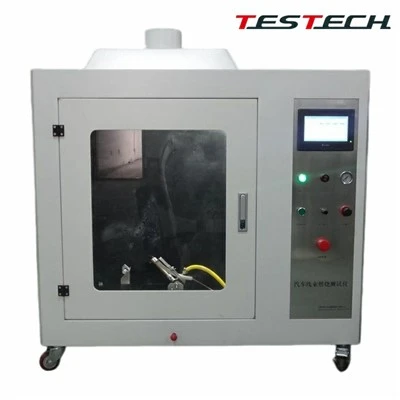
If you’re upgrading your tester, or just tired of the old ones that waste your time and risk your compliance, hit us up to chat. We can walk you through which tech fits your needs—whether you’re a small home wiring maker or a big EV components plant. No sales pitch, just straight talk about what’ll work for your operation.
Transportation Material Flammability Tester References:
- International Electrotechnical Commission (IEC). (2023). IEC 60332-3:2023, Standard for Flame Propagation Tests for Cables.
- Underwriters Laboratories (UL). (2024). UL 1581:2024, Standard for Reference Standards for Electrical Wires and Cables.
- Society of Automotive Engineers (SAE). (2023). SAE J1642:2023, Standard for Flammability Testing of Electric Vehicle Power Cables.
- National Fire Protection Association (NFPA). (2024). NFPA 70:2024, National Electrical Code Requirements for Cable Flammability Testing.
TESTech Instrument (Suzhou) Technologies
TESTech Instrument (Suzhou) Technologies is one of the most reliable wire cable flammability tester manufacturers and suppliers in China. If you’re going to wholesale durable wire cable flammability tester, welcome to get quotation from our factory. For price consultation, contact us.
Address: 8/F, R&D and Production Workshop No. 5, Jiangsu Guoqian Technology Innovation Industrial Park, 168 Lüliangshan Road, Huqiu District, Suzhou, Jiangsu Province, China
E-mail: sales@testech.com.cn
WebSite: https://www.testechfiretest.com/
